
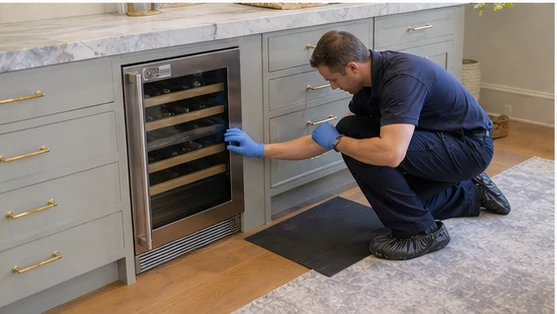
Dependable wine cooler repair for wine and beverage coolers across Larchmont and the surrounding metro.
Wine and beverage units are precision refrigeration, and a few degrees of drift matters when a collection is involved. Most calls we take are temperature complaints: one zone running warm on a dual-zone cabinet, a unit that will not hold its setpoint, or condensation forming on the glass door. The usual causes are a failed thermistor reading the wrong temperature, a tired door gasket letting warm air in, or a condenser and fan that need cleaning and attention.
Dual-zone models add a second sensor and damper, so we confirm which zone is actually at fault before quoting. On glass-door units a door heater keeps condensation off the glass, and when it fails the fogging is often mistaken for a cooling problem. We test the real cause and fit genuine OEM parts so the cabinet holds steady again.
What We Fix
- Dual-zone temperature calibration
- Thermistor and temperature-sensor replacement
- Compressor and thermoelectric-module diagnosis
- Door-seal and glass-door alignment
- Interior lighting and control-panel repair
Have a wine cooler problem?
Common Problems
- One zone holding well off its set point
- A cabinet that never reaches the target temperature
- Condensation collecting on the glass door
- A fan running nonstop or not at all
- Display lights flickering or failing to respond
Typical Causes
- A thermistor feeding the control a bad reading
- A worn or leaking door seal admitting humidity
- A cooling fan too weak to move air across the zones
- A thermoelectric module wearing out on compact units
- A control board that has lost its zone setpoints
Brands We Service
We service wine and beverage coolers across every brand in our roster. On the wine cooler side that means Sub-Zero and Wolf work most, alongside Thermador, Miele, Bosch, and the rest of the luxury lineup.
Error and Fault Reference
Below are the indications we meet most on wine and beverage coolers. Each one narrows the wine cooler to a circuit, and we confirm the true cause with hands-on testing before a part goes in.
| Code | What It Means | What We Check |
|---|---|---|
H1 / HI | Temperature above the set range | Check the sensor, fan, and door seal |
L1 / LO | Temperature below the set range | Verify the thermistor and control calibration |
E / Er | General sensor or control fault | Inspect wiring, then test the board |